



The Ministry of AI Fiasco: How Dominic Smith Sold Trinidad's Digital Sovereignty to OpenAI — Then Let the Government Get Hacked
In May 2025, Trinidad and Tobago did something no other country in the Caribbean had done, and something almost no government on earth had done: it put the words "Artificial Intelligence" in the name of a cabinet ministry. The Ministry of Public Administration and Artificial Intelligence (MPAAI) was announced as a bold leap into the future, a signal that a twin-island republic of 1.4 million people intended to lead the region into the AI age. Fourteen months later, that same ministry could not keep its own government websites from being defaced and redirected to an online gambling site. Welcome to the Ministry of AI under Senator Dominic Smith — long on slogans, short on the boring competence that actually protects a nation.
This is a critical review of the missteps. Not the press-release version. The version where you ask the obvious questions and the answers keep coming back embarrassing.
A "world first" built on branding, not capacity
Let us start with the origin myth. The government loves to describe the MPAAI as the first ministry of its kind — the first in the Caribbean to formally carry an AI mandate, and among the very first anywhere to brand a ministry around artificial intelligence. It sounds visionary. But naming a ministry after a technology is not the same as building the technology, the talent pipeline, the data-protection law, or the security posture to wield it responsibly.
The MPAAI was not born out of a decade of investment in local machine-learning research or a national data-governance framework. It was born out of a merger — the old Ministry of Public Administration bolted onto the former Ministry of Digital Transformation, with "Artificial Intelligence" stapled to the letterhead. A rebrand is cheap. Sovereignty, security, and capability are expensive. From the very first day, the ministry chose the cheap thing and called it leadership.
Who is Dominic Smith — and why is he running national AI policy?
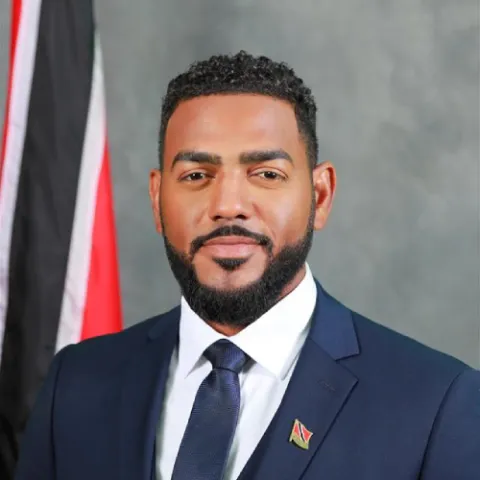
Senator Dominic Alexander Smith holds a Master's in Economics from UWI, St. Augustine, and ran a private digital-consultancy firm before entering cabinet. In the 2025 general election he stood as the UNC candidate for Malabar/Mausica — and lost. He did not win a single seat from the electorate. He was then appointed to the Senate and handed one of the most consequential portfolios of the digital era: the artificial-intelligence future of an entire nation.
There is nothing unusual about a senator serving in cabinet; that is how the system works. But there is something worth saying plainly: the man steering Trinidad's most future-facing ministry is a rejected-at-the-ballot consultant whose instinct — as we will see — has been to reach for a foreign vendor and a photo-op rather than to build anything Trinidadian. A consultant runs a ministry the way a consultant runs anything: sign the deal, book the summit, issue the release, move on.
Misstep #1: Handing the nation's education system to OpenAI
In January 2026, Smith stood up and announced the ministry's flagship achievement: a partnership with OpenAI to pilot its "Education for Countries" initiative, pushing ChatGPT Edu into Trinidad's schools and universities. Trinidad joined Estonia, Greece, Jordan, Kazakhstan, Slovakia and the United Arab Emirates as a pilot country. Smith called OpenAI "the global leader in artificial intelligence, research and deployment" and the deal "a pivotal milestone."
Read that again. The Minister of Artificial Intelligence introduced his AI policy by praising an American private corporation as the global leader — and then wired that corporation directly into the minds of Trinidadian schoolchildren. This is the entire problem in one sentence.
Ask the questions the ministry did not answer:
- Where does the data live? Student prompts, learning records, and behavioural data generated by ChatGPT Edu — is any of it stored in Trinidad, under Trinidadian law? The announcement never said. The data-sovereignty questions were simply skipped.
- What did it cost? No figure was disclosed. "Free" pilots from Silicon Valley are never free — the currency is your data and your dependency.
- What happens when the pilot ends? Once teachers, curricula and government workflows are built around one company's model, switching becomes impossible. That is vendor lock-in, and it is the whole business model.
- Why not build local capacity? Not one cent of that "milestone" appears to fund Trinidadian AI engineers, open models, or a sovereign data centre. We are renting our future from California.
This is not AI leadership. It is digital colonialism with a ribbon-cutting. A genuinely sovereign AI policy would have started with a national data-protection regime, public compute, and homegrown talent. Instead, the ministry's signature move was to make Trinidad a test market for a foreign firm and call the arrangement an honour. When Smith was pressed on jobs, the best he could offer was the hollow reassurance that "technology should not replace people." Slogans do not write policy.
Misstep #2: A Ministry of AI that couldn't keep the lights on
Then came July 2026, and the mask slipped completely. Multiple government websites — including the Industrial Court, the Service Commissions Department, and the Housing Development Corporation (HDC) — were compromised. Some were defaced. Some redirected visitors to a fraudulent online gambling site. This is the digital face of the state, and under the Ministry of Artificial Intelligence it was pointing citizens toward a casino scam.
Here is the detail that should end careers. The alarm was not raised by the Ministry of Artificial Intelligence. It was not raised by any of the ministry's much-advertised "AI-powered" monitoring. It was raised by an independent citizen — IT consultant Shivam Teelucksingh — who had been quietly documenting a wave of compromised government websites across Trinidad and the wider Caribbean. The ministry whose entire job is national digital modernisation had to be told by a member of the public that the government was bleeding.
And how did the Minister of Artificial Intelligence respond to a national security embarrassment? He downplayed it. Smith's words: "I'm aware of the service disruptions. Some are related to maintenance issues involving third-party service providers." Officials briefed that these were "not sophisticated, targeted cyberattacks" but merely "the exploitation of known vulnerabilities by malicious bots."
Sit with that spin for a second, because it is an admission disguised as a defence. They are telling you the attacks were not sophisticated. They are telling you these were known vulnerabilities — outdated software, unpatched plug-ins, poorly maintained servers — that any competent web team patches as routine housekeeping. In other words: the Ministry of Artificial Intelligence got beaten by automated bots exploiting bugs that were already known and already fixable. That is not bad luck. That is negligence. Teelucksingh himself called for "a full audit of government services," pointing out that basic maintenance — "updating servers, checking vulnerable plug-ins and maintaining systems" — would have prevented most of it.
You cannot credibly ask a nation to trust you with frontier artificial intelligence — with the data of every schoolchild and public servant — when you cannot run a WordPress update. The gap between the ministry's ambitions and its competence is the entire story.
Misstep #3: The nation's open data has gone dark — and stayed dark
Here is the misstep that ties the whole record together, and it is the one that should make every citizen furious. Trinidad and Tobago's official open-data portal, data.gov.tt — the single government platform meant to publish public datasets openly, for reuse, research and accountability — is down. Visit it right now and you are met with one line: "Data.gov.tt — Under Maintenance." No datasets. No statistics. No public access. And it has been that way since December, month after month, with no restoration and no real explanation.
Read that against everything above. The Minister of Public Administration and Artificial Intelligence — a portfolio whose entire reason to exist is data, digital service, and transparency — has presided over the disappearance of the government's own transparency platform. The one tool that let journalists, researchers and ordinary Trinidadians check the state's numbers has simply been switched off, indefinitely, while the same ministry finds plenty of time to fly to summits and sign deals with OpenAI.

Call it what the effect is: the data is now hidden. Whether by neglect or by design, the result is identical — the public can no longer see it. A government that genuinely wanted openness does not leave its flagship open-data site "under maintenance" for the better part of a year. It treats a months-long transparency blackout as the emergency it is. Instead, the silence has been total. When the platform that is supposed to keep the state honest is dark for this long under the very ministry responsible for it, the public is entitled to ask the obvious question: what is it that we are no longer allowed to see?
It fits the pattern exactly. The OpenAI deal's terms were never published. The breach was downplayed instead of disclosed. And the one portal built to give citizens direct access to government data has been offline since December. Downplay, don't disclose; announce abroad, hide at home. That is not the behaviour of a ministry building an open, AI-ready nation. It is the behaviour of one managing the optics while the substance rots.
The pattern: summits abroad, negligence at home
While government sites were being redirected to scam pages, the ministry's public agenda was dominated by the things ministries love: a UNESCO "AI readiness assessment," an invitation for Smith to represent Trinidad at the AI Impact Summit 2026 in India, glossy "open house" events, and a steady drip of releases about "citizen-centred, innovation-driven governance." The frequent-flyer miles pile up; the servers stay unpatched.
This is the recurring failure of the entire project. The MPAAI treats artificial intelligence as a branding and diplomacy exercise — summits, partnerships, buzzwords — rather than as an engineering and security discipline. AI is not a press release. It is data pipelines, model governance, patch management, incident response, and hard local capability. On every one of those unglamorous fronts, the record so far is failure or absence.
What real AI leadership would have looked like
A serious Ministry of Artificial Intelligence would have inverted every one of Smith's priorities:
- Security first. Before a single "milestone" partnership, it would have ordered the full government-wide security audit — the one an outside consultant had to demand — and closed the known vulnerabilities that let bots deface the state.
- Sovereignty by design. A national data-protection and AI-governance law, with a hard rule that citizens' and children's data stays under Trinidadian jurisdiction — before plugging OpenAI into the classroom.
- Build, don't just buy. Fund local AI engineers, university research, and open-source or sovereign models so Trinidad owns capability instead of renting dependency.
- Transparency. Publish the cost, the terms, and the data-handling arrangements of every vendor deal. The public paid for it; the public should see it.
None of that happened. Instead we got the opposite order of operations: sign with the foreign giant, celebrate the "world first," and discover the security hole only when a citizen and a bot found it first.
The verdict
Trinidad and Tobago's Ministry of Artificial Intelligence was sold as a first-of-its-kind national triumph. Under Dominic Smith it has, so far, delivered three things: a surrender of digital sovereignty to OpenAI dressed up as a “pivotal milestone”; a cybersecurity embarrassment in which arms of the state were defaced and pointed at gambling scams — caught not by the ministry but by a private citizen, and then waved away as a “maintenance issue”; and a transparency blackout in which the national open-data portal has sat dark since December, hiding the public’s own data behind an endless “Under Maintenance” screen.
You do not become an AI nation by putting "AI" in a ministry's name. You become one by doing the hard, unglamorous, sovereign work of building and defending your own systems. On that test, the MPAAI has failed — and until it is measured by delivery instead of by announcements, it will keep failing. Trinidad deserved a strategy. It got a slogan and a scam redirect.
Sources & further reading
- CNC3 — "Govt probes cybersecurity attacks on several ministries, State agencies" (video report referenced: @CNC3TV on X)
- Trinidad and Tobago Newsday — "Trinidad and Tobago partners with OpenAI for education programme"
- MPAAI — Official OpenAI partnership release and Minister's profile
- Government of Trinidad and Tobago Open Data Platform — data.gov.tt (showing "Under Maintenance" — no datasets accessible)