



While the whole country was busy cheering the shiny word "AI," the government slipped a war-metal deal past us in the very same breath. On 10 July 2026, Prime Minister Kamla Persad-Bissessar's government signed three Memoranda of Understanding with United States organisations. Two were about data centres and artificial intelligence — and we are, for the record, strongly in favour of a national data center. But the third MOU is a different animal entirely, and it deserves its own hard, cold look.
Because Memorandum of Understanding number three would turn Trinidad and Tobago into a strategic metals supplier to the United States military. Read that again. Not a tech hub. Not a green-battery pioneer. A cog in the supply chain of American warplanes.
What the Deal Actually Says
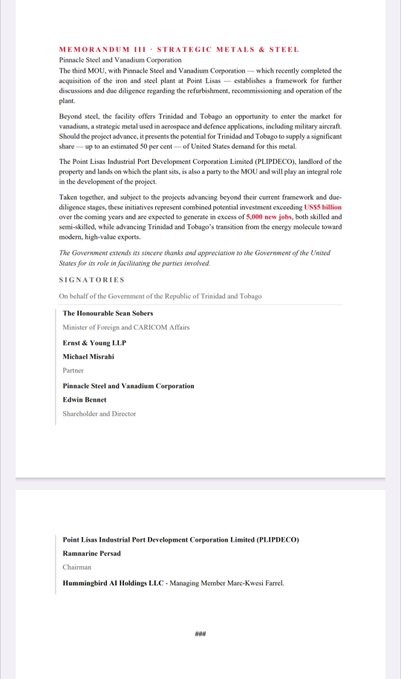
The third MOU is with Pinnacle Steel and Vanadium Corporation, a US firm that — in the government's own words — "recently completed the acquisition of the iron and steel plant at Point Lisas." That is the plant ArcelorMittal walked away from and shuttered back in 2016, throwing hundreds of Trinbagonians on the breadline. The MOU is a framework to refurbish, recommission and operate it. So far, so reasonable — reopening a dead plant sounds like good news.
Then comes the real payload. Quoting the release directly: "Beyond steel, the facility offers Trinidad and Tobago an opportunity to enter the market for vanadium, a strategic metal used in aerospace and defence applications, including military aircraft. Should the project advance, it presents the potential for Trinidad and Tobago to supply a significant share — up to an estimated 50 per cent — of United States demand for this metal."
And who arranged all this? The release ends by thanking "the Government of the United States for its role in facilitating the parties involved." The state landlord, PLIPDECO, is a party to the deal. The whole package — data centres, AI and war-metal — is dressed up as US$5 billion in potential investment and 5,000 jobs. The signatures on the steel MOU: Sean Sobers for the Government, and Edwin Bennet, Shareholder and Director of Pinnacle Steel and Vanadium Corporation.
What Is Vanadium — and Why Does the Pentagon Want It?
Vanadium is a hard, silvery metal that does one thing better than almost anything else: it makes other metals stronger and lighter. Add a little vanadium to steel and you get high-strength alloys. Add it to titanium and you get the superalloys that build jet engines, airframes, missiles and armour. It is on the United States' official list of critical minerals precisely because America barely produces any of its own and depends on imports to feed its defence industry.
Yes, vanadium has peaceful uses too — reinforcing bar for construction, and vanadium "flow batteries" for storing renewable energy. We will not pretend otherwise. But notice something: the government did not sell this deal on rebar or green batteries. They themselves chose to headline "aerospace and defence applications, including military aircraft." When your own press release leads with military aircraft, do not act surprised when the people read it as a military deal.

Arming the Empire From Our Own Soil
Here is what should chill every conscious Trinbagonian. This is a US-brokered deal, with a US corporation, to make a strategic war-metal for the US military — and it lands at the exact moment the United States is massing warships and threatening our neighbour, Venezuela, just seven miles across the water. The same empire that this government helped shield at the UN over Cuba. The same government we have long argued is behaving like a vassal of Washington. Now the mask is off: we are to forge the metal for the very warplanes that could one day scream over the Gulf of Paria.
Trinidad and Tobago has, for two generations, claimed the mantle of non-alignment — a small nation that takes no side in great-power wars. To become a supplier of "up to 50 per cent" of a great power's war-metal is to tear that mantle off and set it on fire. You cannot be neutral and be the arsenal at the same time. A country that forges the empire's swords has already picked a side.
You cannot claim to be non-aligned while forging the empire's weapons. The nation that arms the war machine has already chosen its master.
Trinidad and Tobago Revolutionary Socialist Party

Who Really Benefits?
Follow the metal. The United States has a strategic vulnerability: it does not control enough vanadium and leans on imports for its defence supply chain. This deal solves Washington's problem, not ours. America gets a secure, offshore, friendly source of a critical war-metal — parked in a compliant client state it can lean on. Pinnacle Steel and Vanadium Corporation, a private US company, gets a shuttered plant and the profits. And Trinidad and Tobago gets… what, exactly? A number on a press release and the honour of being written into the Pentagon's supply chart.
We are told 5,000 jobs and US$5 billion. But every word of that is conditional — "potential," "expected," "subject to due diligence." It is an MOU, not a contract. Nothing is signed in blood yet. Meanwhile the strategic cost is very real and very permanent: once you are the empire's metal supplier, you do not get to be neutral in the empire's next war. We have been down the road of foreigners owning our resource base before — read our history of who has plundered this country — and the jobs are always temporary while the dependency is forever.
The Bundling Trick
Understand the sleight of hand. A genuinely good idea — a national data center, which we support — was announced on the same day, in the same release, by the same minister, as a deal to arm the American war machine. That is not a coincidence; it is packaging. The AI headline is the sugar; the war-metal is the pill. Cheer for the data center if you like — we do — but do not let its glow blind you to what was smuggled in beside it. Judge each MOU on its own terms.
What We Demand
1. Publish the full MOU. Not a press conference — the document, laid in Parliament, debated in the open.
2. No war-metal without a national conversation. The people of this country never voted to become a military supplier to a foreign power. Ask them.
3. Reopen the steel plant — for us. We want Point Lisas alive again. Let it forge steel for Trinbagonian housing, schools, bridges and a regional construction boom — not titanium alloys for someone else's fighter jets.
4. Keep our neutrality. A small nation's greatest defence is being no one's arsenal. Do not trade it for a conditional press-release number.
Build the data center. Reopen the plant. But we will not quietly become the forge of the American war machine while the empire circles Venezuela on our doorstep. Not in our name.