




Two days ago we published our case for a sovereign data centre, and we meant every word: Trinidad and Tobago needs its own data centre — built here, owned by the people, powered by our own gas. We are for the machine. What we are firmly against is the government's answer to the one question that matters as much as ownership: where are you putting it?
Because the answer that has now come back is the wrong one. Public Utilities Minister Barry Padarath has confirmed the plan: "The location of the data centres are meant to be in a special economic zone. We are looking particularly at Debe for these data centres." Not the industrial estate that was purpose-built for exactly this. Debe. A village. A farming community. A place where people live, plant, and pray the rainy season is kind to them. We say plainly: this does not belong in Debe. It belongs at Point Lisas.

You do not put a 200-megawatt furnace in a breadbasket. You put it in the industrial estate you already built for furnaces. That estate is called Point Lisas.
Trinidad and Tobago Revolutionary Socialist Party
What Is Actually on the Table
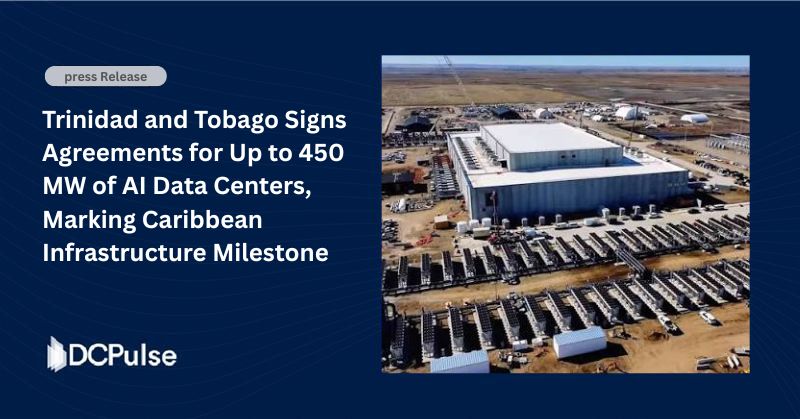
The scale is not small. Off the back of the July 2026 Memoranda of Understanding — Ernst & Young LLP with a 300 MW data centre, and Hummingbird AI Holdings with 150 MW rising to 500 MW — we are talking about up to 800 megawatts of foreign-owned compute, targeting first operation around 2028. We broke down the ownership trap in that first article, and it still stands. But an 800 MW installation is not a "tech park." It is heavy industry: transformers, turbines, cooling plants, generators, transmission lines, and a thermal footprint the size of a small town. Ask yourself honestly where a project of that weight belongs — beside ammonia plants and port cranes, or beside a primary school and a cassava field?
Point Lisas Is the Site. It Was Always the Site.
We are not inventing an alternative to be difficult. The Point Lisas Industrial Estate is the single most obvious location in the entire country for a power-hungry data centre, and here is why:
• It is already heavy-industrial. Ammonia, methanol, and steel plants run there day and night. There is no quiet village to wake, no farmland to pave, no residential community living downwind of the plume.
• It is already zoned and serviced. The land is designated for exactly this kind of use. The permits, the buffers, the industrial classification — all in place. PLIPDECO exists to manage precisely this.
• It already has the power. Point Lisas sits on the gas grid that feeds the petrochemical sector. Feeding turbines there is a solved problem; feeding 800 MW into rural Debe is not.
• It has the port. Heavy equipment, transformers and cooling gear land at Point Lisas. Debe has no such logistics.
• It has under-used capacity right now. With our LNG economy in structural decline and plants sitting under-fed, Point Lisas has idle industrial land and stranded gas begging for a new anchor tenant.

A humming data centre dropped into an existing industrial park disturbs nobody. Dropped into Debe, it disturbs everybody. This is not a close call. The state built an industrial estate for industrial installations, and then decided to send an industrial installation somewhere else. That decision demands an explanation the government has not given.
What Debe Actually Is — and Why It Is the Wrong Place
Debe is not a blank space on a map. It is the heart of agricultural south Trinidad — market gardens, provision grounds, and the farmers who feed a serious share of this nation's local produce. It is one of the places our food actually comes from. When the residents heard the news, they were blindsided. Jared Greenidge said the project "just came out of nowhere" and slammed the total absence of community consultation. Tazim Hosein cut to the bone: "For who? The people of Debe? What would benefit us at the end of the day?" These are exactly the right questions, and no minister has answered them.
Look at what the residents themselves flagged, because they know their own land better than any consultant:
• Flooding. Residents named it immediately, and anyone who knows Penal–Debe knows why: this is flood country. Now imagine paving over farmland and drainage to lay down concrete pads, hardstanding and access roads for a hyperscale campus. You do not solve flooding by sealing the ground that used to absorb the rain.
• A grid that already sags. One resident described the "occasional low-voltage electricity problems" they live with now. That is the grid you want to hang 800 MW of new industrial load beside?
• Water they cannot spare. The government's own fix tells the story: to supply the site, Minister Padarath proposes man-made ponds in the short term and desalination plants in the long term, plus new facilities in Moruga Tableland and Mayaro to ease reliance on the Navet Dam. Stop and read that again. If you have to build ponds and desalination plants just to water the site, the site is telling you it is the wrong site. Point Lisas sits on the coast with industrial water already engineered for it.
We have said before that this country has a water management problem, not a water supply problem — and we stand by demanding a real closed-loop, zero-discharge cooling system whatever gets built. But closed-loop cooling is an argument for building it right, in the right place. It is not a licence to plant an industrial water-and-power monster in the middle of a farming district that already fights WASA for a trickle, the same way communities across this country fight for clean water every single day.

Data Centres Heat the Land — This Is Not Speculation
Here is the part almost nobody in the government is talking about, and it is the part that should end the Debe conversation on its own. A data centre is a giant heater. Nearly all the electricity it draws — hundreds of megawatts — comes back out as waste heat. That heat does not vanish. It pours into the air and the land around the building, and the research on this has hardened fast:
• Land around data centres has measured roughly 2°C (about 3.6°F) hotter on average since the machines switched on.
• Data centres can push nearby air temperatures up by as much as 4°F, creating localised "heat islands."
• The thermal plume and warming can extend well beyond the fence line — studies report measurable land-temperature rises kilometres away, with an estimated 340 million people worldwide already living within six miles of a hyperscale data centre.
• Every degree of extra heat drives entire neighbourhoods to run more air conditioning — which dumps more heat back outside, in a vicious loop.
Now apply that to Trinidad. We are a tropical country that is already hot, already humid, already warming. Put a heat island in the Point Lisas industrial estate and the neighbours are ammonia plants and port cranes — they do not care. Put that same heat island in Debe and you are cooking homes, schools, and living crops in a climate that punishes every extra degree. Heat stress does not just make life miserable for families; it wilts fields, lowers yields, and stresses livestock. You would be raising the temperature of a farming community to cool a billionaire's chatbot. That is not development. That is a burn injury dressed up as progress.
Waste heat does not read the property line. In an industrial park, nobody is harmed by it. In a farming village, it lands on people and on the food they grow.
Trinidad and Tobago Revolutionary Socialist Party
So Ask the Real Question: Is Choosing Debe Political?
If Point Lisas is the obvious, cheaper, safer, already-serviced industrial site — and it is — then why has the government "particularly" chosen Debe? When the engineering answer is this clear and the government picks the opposite, you are no longer looking at an engineering decision. You are looking at a political one. And Debe is not politically neutral ground. Penal–Debe is UNC heartland, one of the safest constituencies the governing party holds.
So we have to say out loud what many are thinking. There are two cynical readings of why an 800 MW foreign installation gets routed into a loyal rural base instead of the industrial estate up the road, and neither flatters the government:
• The optics play. Announce "development" and "jobs" for the base, cut a ribbon in the heartland, and bank the goodwill — a shiny AI photo-op for the constituency, with 2028 in mind. The Ministry of Artificial Intelligence already runs on press releases; this would be the press release with a building attached.
• The sacrifice-zone play. The colder, uglier reading: put the heat, the water strain, the flooding risk and the environmental burden on a community that will vote UNC regardless. When the political cost of harming a place is near zero, the powerful treat it as expendable. That is how loyal communities get used — not rewarded.
We reject both. A farming community is not a campaign backdrop, and it is not a sacrifice zone. The people of Debe deserve to be treated as citizens with land, water and lungs to protect — not as a safe seat whose loyalty can be cashed in for a US corporation's cooling bill. If this project is genuinely good, it is good enough to sit at Point Lisas where it belongs. The only reason to force it into Debe is a reason that has nothing to do with the servers.

The Same Giveaway, Now With a Worse Address
None of this replaces the ownership fight — it stacks on top of it. This is still a deal where the named partners are a consulting firm and a holding company, where the real owner is a blank space, and where the profits look set to leave for Wall Street while we hand over the gas, the land and now potentially the farmland and the water. It is the contract mafia playbook we have watched hollow out this country for fifty years — only this version also asks a farming village to absorb the heat and the flooding. And remember it arrived bundled with a vanadium-for-the-war-machine steel deal at Point Lisas. So the irony writes itself: the war-metal plant gets the industrial estate, and the food-growing village gets the industrial data centre. That is exactly backwards.
"Concerns Will Be Addressed" — After the Site Is Already Chosen?
As the backlash grew, the government moved to reassure the public that the environmental, technical and regulatory concerns "will be thoroughly examined before any construction begins," with experts brought in to weigh the risks. It sounds responsible. Look closer and the sequence is backwards. The MOUs are signed. The capacity — up to 800 MW — is set. The Public Utilities Minister has already named the site: "particularly Debe." Only now, after all of that, are we told the experts will study whether it is a good idea. You do not pick the location and announce it to a blindsided village, and then commission the study that is supposed to decide the location. That is not due diligence. That is a rubber stamp being warmed up.
And the public is not buying it. A Change.org petition to halt the data centres gathered more than 3,200 verified signatures in under a day — its central complaint the very thing this government keeps waving away: a country already in a longstanding water crisis, where households ration supply, keep tanks on the roof and wait on truck-borne deliveries, is being asked to host some of the most water- and power-hungry machines on earth. Globally, data centres are projected to consume close to 3% of the world's electricity by 2030, according to a United Nations University report. This is not a small ask being dropped on Debe. It is a planetary-scale industrial load.
The framing now being pushed is this: the question is no longer whether Trinidad and Tobago wants to become a data centre hub, but whether its water and power infrastructure can be built out fast enough to support the market. Read that carefully, because it quietly concedes our entire argument. If the honest question is whether we can build out the water and power fast enough — new ponds, new desalination plants, new grid capacity, all from scratch — then the chosen site does not have that water and power today. You do not "build out fast enough" what already exists. And the place where it already exists — the water, the gas grid, the industrial power, the port — is Point Lisas. The infrastructure question is not an argument for racing to prop up Debe. It is the clearest possible argument for not putting it in Debe at all.
If your defence of the site is that you'll build the water and power to support it "fast enough," you have just admitted the site cannot support it. Point Lisas needs no such promise.
Trinidad and Tobago Revolutionary Socialist Party
Our Demands
1. Site it at Point Lisas. Or at the state's own half-built Tamana InTech Park at Wallerfield — an existing technology estate, far from residential communities, waiting for exactly this. Not Debe.
2. No shovel without a full EIA. A published, independent Environmental Impact Assessment covering heat, water, flooding and grid load — before any site is confirmed, not after the concrete is poured.
3. Real consultation in Debe. The people Greenidge and Hosein speak for were told nothing. Consultation is a right, not a courtesy.
4. Publish the deal. Ownership, the tax holidays, the gas price, the land, the water guarantees — all of it, as we demanded from day one.
5. Closed-loop, zero-discharge cooling, in law. Wherever it lands, not one river poisoned and not one community's water touched.
Build It — In the Right Place
Let there be no confusion, because our opponents will try to twist it: we have not changed our position by one inch. We want the data centre. We want Trinidad and Tobago to be the compute power of the Caribbean. We want our gas turned into value and our young engineers given a reason to stay home. Build it. Build it big, build it public, build it green.
But build it in the industrial estate the nation constructed for heavy industry — Point Lisas — not in the fields where our food grows and our families live. A data centre in Debe heats the land, strains the water, floods the low ground and hands a safe-seat community the bill for a foreign corporation's servers. A data centre at Point Lisas does the same work with none of the harm. The choice between those two is not hard. That the government is making the wrong one — "particularly" the wrong one — tells you everything about whose interests are really being served. Not in Debe. Point Lisas. Full stop.