



Let us be clear from the first line, because our comrades will ask: yes, we are revolutionary socialists, and yes, we say build the data center. Build it big. Build it here. And build it so that the people of Trinidad and Tobago own every rack, every processor and every watt inside it.
There is no contradiction. Socialism has never been against machines — it has been against the few owning the machines that the many depend on. In the twentieth century the means of production were steel mills, oil refineries and the land. In 2026 the decisive means of production is compute: the raw processing power that trains and runs artificial intelligence. Whoever owns the compute owns the future. Right now, Trinidad and Tobago owns none of it — and that is the emergency this article is about.
The Deal on the Table: Three MOUs, All American
This is not hypothetical anymore. On 10 July 2026, under the leadership of Prime Minister Kamla Persad-Bissessar, the Government executed three Memoranda of Understanding — all with United States organisations — signed on our behalf by Sean Sobers, Minister of Foreign and CARICOM Affairs. Here is what was actually put on the table:
• MOU I — Ernst & Young LLP (Data Centres). A framework to develop large-scale data centres using EY's "Energy to Intelligence (E2I)" platform, under which EY "intends to partner with third parties" to develop a 300 MW data centre.
• MOU II — Hummingbird AI Holdings LLC (AI Infrastructure). Preliminary cooperation and due diligence on a proposed 150 MW AI and data-centre facility, with potential expansion to 500 MW, targeting first commercial operation in Q1 2028.
• MOU III — Pinnacle Steel and Vanadium Corporation (Point Lisas). The US firm that recently acquired the old iron and steel plant, for refurbishment and recommissioning — and, beyond steel, to produce vanadium, a strategic metal, with PLIPDECO as a party to the deal.
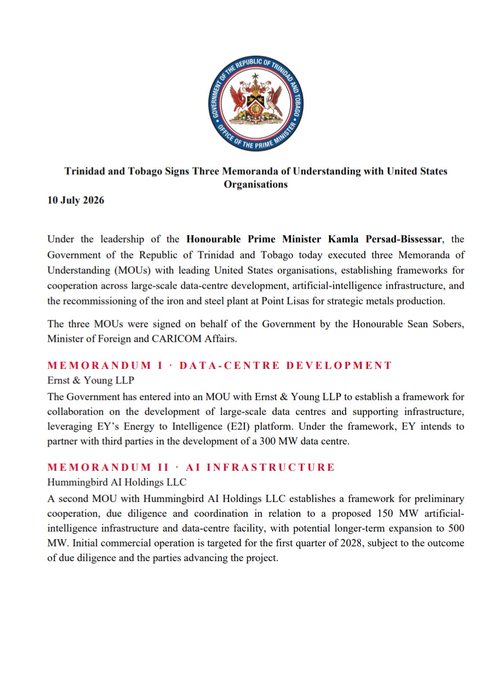
The government's headline numbers: combined potential investment exceeding US$5 billion and in excess of 5,000 new jobs. And a telling closing line in the release — the Government "extends its sincere thanks" to the Government of the United States for "facilitating the parties involved." Sit with that. Washington brokered this. These are not deals we went out and won; they are deals that were arranged for us.
Read those two words carefully: Memorandum of Understanding. An MOU is not a binding contract. It is a letter of intent — a handshake, a "framework for cooperation," a photo-op. Nothing is finalised. The US$5 billion is "potential." The 5,000 jobs are "expected." Everything is "subject to due diligence." No terms, no ownership split, no price, no guarantees are locked in. Which means the moment to fight for the citizens' interest is right now, before these frameworks harden into contracts we cannot unwind. This article is that fight.
What Is a Data Center, and Why Should a Trini Care?
A data center is a warehouse of computers — thousands of servers stacked together, wired to fast internet, fed by reliable electricity and kept cool so they do not melt. Every app on your phone, every WhatsApp voice note, every Google search, every ChatGPT answer runs inside somebody's data center. The AI revolution everyone is talking about is not magic in the cloud. The "cloud" is a building. It has a roof, a power bill and an owner.
Here is the humiliating truth: there is not a single serious AI-grade data center in Trinidad and Tobago. When our banks, our government, our schools and our businesses use "the cloud," that building sits in Virginia, in São Paulo, in Ireland — anywhere but here. We rent our own digital lives back from foreign corporations, in foreign currency, on foreign terms. That is not modernity. That is digital colonialism, and we are paying rent to our colonisers.
The cloud is not in the sky. It is a building. And right now, ours is in another country.
Trinidad and Tobago Revolutionary Socialist Party
Trinidad Is Missing the AI Rush — Again
We watched the internet boom pass us by. We watched the fintech boom pass us by. We watched crypto and the app economy pass us by while our brightest young programmers packed their bags for Toronto, London and Miami. Read our piece on the Trinidad brain drain if you want to feel the loss in your chest. Every time a new frontier opens, we send a delegation to a conference, print a glossy report, and do nothing.
The AI rush is the biggest of them all, and it is happening right now. The UNC government's cabinet has an "AI Ministry" for photo-ops, but you cannot run a national AI strategy on press releases when you do not own a single GPU cluster. You cannot be a player in a game whose stadium you refuse to build. As we argued in AI and Robotics in Trinidad and Tobago, the choice is not whether AI arrives — it is whether we arrive as owners or as tenants.

Read the Fine Print: Whose Data Center Is This, Really?
Here is where we part ways with the cheerleaders. Being pro data center is not the same as being pro any deal a minister signs behind closed doors. A data center is coming — good. But the question that decides whether this is a blessing or a fresh chapter of plunder is simple: who owns it, and who profits from it?
We have seen this movie before. A foreign multinational flies in, dangles "investment" and "jobs," and walks away with a sweetheart contract: decades of tax holidays, cut-price land, subsidised gas, guaranteed profit repatriation in US dollars — while the people of Trinidad and Tobago are left holding the environmental risk and a handful of security-guard jobs. That is the contract mafia playbook, and it has hollowed out this country for fifty years. We will not applaud it just because this time it is painted in AI buzzwords.
So before a single ribbon is cut, the citizens of this country are owed answers. Demand this deal be published in full. Not a press conference — the actual contract:
• Who owns the equity? Is this a US corporation's building sitting on our soil, extracting rent — or does the state and the people hold a controlling stake?
• Where does the profit go? Does it circulate at home, or get repatriated to Palo Alto and Wall Street in foreign currency?
• What are we giving away? How many years of tax holidays, how much subsidised gas and electricity, how much free or discounted state land?
• Who controls the data? Will Trinbagonian government and citizen data sit under foreign law, exposed to foreign subpoenas and sanctions — or under our sovereignty?
• Who carries the risk? If the water, the power grid or the environment is damaged, who pays to fix it — the corporation, or the taxpayer, as always?
And this deal specifically raises every one of those flags. Ernst & Young is a consulting and accounting firm — not a data-centre operator. The MOU says EY "intends to partner with third parties." So who are the third parties who will actually own and run the 300 MW facility? We are not told. We are being asked to bless a deal where the named partner is a middleman and the real owner is a blank space. Hummingbird AI Holdings LLC lists a managing member, Marc-Kwesi Farrel, but a limited-liability company can still keep its real capital and backers behind a single name — so who is funding it, and what is their record building infrastructure at this scale? Before a single acre or cubic foot of gas is committed, the people are entitled to know exactly whose building this will be.
Then there is the number nobody in the government wants to say out loud: power. EY's 300 MW plus Hummingbird's potential 500 MW is up to 800 megawatts of demand. Trinidad's entire national peak electricity demand is on the order of 1,300 MW. In other words, these two American projects could consume a share of our national power supply so large it beggars belief — and every watt of it burned from our natural gas. So the citizen's question sharpens to a point: are we going to subsidise cheap gas and power so a US corporation's servers can run, while Trinis pay rising electricity bills and pray the grid holds? Cheap sovereign power is only an advantage if we capture the value. Hand it to a foreign owner at a subsidised rate and we are simply exporting our gas at a discount and calling it progress.
If the answers are "a US corporation owns it, the profits leave, and we gave away the gas and the land for a photo-op," then this is not development — it is digital colonialism with a local flag painted on the gate. A data center that enriches a Silicon Valley shareholder while a Trini pensioner's data is stored under American law is a bad deal, full stop. We are pro data center. We are anti giveaway.
Being pro data center does not mean being pro whatever deal a minister signs behind closed doors. Publish the contract.
Trinidad and Tobago Revolutionary Socialist Party
One warning before we go on, because it was bundled into this very announcement: the third MOU — the Point Lisas steel plant — is not really about steel. In the government's own words it is about vanadium, "a strategic metal used in aerospace and defence applications, including military aircraft," to supply up to half of United States demand. That is a war-metal deal riding in on the coat-tails of the AI headline, and it deserves its own scrutiny. We break it down in full here: Vanadium for the War Machine — Trinidad's Point Lisas Steel Deal and the US Military. For this article, keep the focus where it belongs: the data center itself, which we support — on the right terms.
Our Secret Weapon: We Are Sitting on the Fuel
Here is what the doubters miss. The single biggest cost of running a modern AI data center is electricity — these machines are ravenous. Data centers now compete for power with entire cities. And what is the one thing Trinidad and Tobago has in abundance, cheap, right under our feet?
Natural gas. We are one of the most gas-rich nations in the hemisphere. Our LNG economy is in structural decline — the gas promises keep dissipating, majors are drawing down, and Point Lisas plants sit under-fed. We have stranded gas, idle industrial estates and world-class energy engineers with nowhere to point their talent. A sovereign data center is the perfect landing pad for all of it.
Picture it: a national data center at Point Lisas or the Tamana InTech Park at Wallerfield, powered directly by our own gas turbines at a fraction of what our competitors pay for grid electricity. While Silicon Valley begs for power and gets blocked by neighbours, we would be sitting on the cheapest AI fuel in the Caribbean. Our declining petrostate becomes a compute state. That is not fantasy — that is industrial policy staring us in the face.

"But What About the Water?" — The Closed-Loop Answer
The honest objection — and the one flooding social media whenever "data center" is mentioned — is water. All over the world, communities are furious because data centers guzzle millions of gallons of fresh water for cooling and dump warm, chemical-laden water back into rivers. In a country where whole communities already fight for clean water and get a trickle from WASA, we will not tolerate a corporation draining the aquifer to cool a billionaire's chatbot. Full stop.
So we build it the right way, from day one: a closed-loop cooling system. In a closed loop, the same coolant circulates through the servers again and again inside a sealed circuit — it is not drawn from a river and it is not discharged into one. Pair it with modern direct-to-chip liquid cooling and immersion cooling, and you eliminate the water-pollution problem entirely. Zero freshwater draw. Zero thermal discharge. Zero contamination of our rivers and sea.
And let us kill a lazy myth while we are here. Trinidad and Tobago does not have a water supply problem. We have a water management problem. The rain falls on this country in abundance — we are not a desert. What we have is a WASA that loses somewhere near half of its treated water to leaking, colonial-era pipes before it ever reaches a tap; reservoirs poorly maintained; and communities dry not because the water does not exist, but because it is squandered on the way to them. So the objection "we cannot spare water for a data center" is aimed at the wrong target. Fix the management, and there is more than enough for the people and the future.
Which leads to the demand we should be hammering at the negotiating table: throw our water infrastructure into the deal. If a corporation wants our land, our gas and our skies to build a data center, then part of the price is that they help fortify our national water and utility infrastructure — fund the replacement of rotting mains, upgrade the pipelines and pumping stations, harden the grid that the community shares with the plant. A data center demands rock-solid power and water reliability anyway; make that investment serve the citizens first, not just the servers. That is how you turn a foreign corporation's appetite into a public good. No fortified infrastructure for the people, no deal.
This is exactly the kind of condition a public owner can impose and a private multinational will always try to weasel out of. A profit-driven corporation cuts the closed-loop system to save money and lets the community drink the consequences. A state-owned, people-owned data center builds it green because the people are the shareholders. Environmental protection is not a cost to us — it is the point. Read our stance on Trinidad's environmental record to see why we will never repeat the sins of the old extractive economy.

Plenty of Remote Land, Zero Excuses
"Where would you even put it?" Everywhere. Trinidad has vast tracts of under-used state land far from residential centres — former Caroni cane lands, the interior around Wallerfield, the deep south, industrial acreage at Point Lisas already zoned and serviced. A data center does not need a beach or a city. It needs land, power, fibre and security — and we have all four. Siting it in a remote area keeps it away from communities, close to gas, and turns "bush" that generates nothing today into the highest-value real estate in the region.
And on the siting the government has actually chosen — Point Lisas — the usual "noise and nuisance" objection barely applies. Point Lisas is already a heavy-industrial estate: ammonia and methanol plants, the steel works, port cranes running day and night. It is zoned, serviced, powered and connected precisely for this. A humming data center dropped into an existing industrial park disturbs no quiet village — there is no pristine community there to wake. On the industrial footprint, Point Lisas is exactly right. Our fight is not with where it goes; it is with who owns it and on what terms.
Update: since we published this, the government has revealed it is "particularly" eyeing Debe — a populated farming community — rather than the industrial estate. That changes everything about the siting, and we oppose it. Read our full case here: Not in Debe: Put the Data Centre at Point Lisas, Not a Farming Village.
Wallerfield already has the bones of the Tamana InTech Park — a technology park the state built and then half-abandoned. Finish it. Fill it. Make it the beating heart of Caribbean compute.
The AI Superpower of the Caribbean
Now think regionally. Barbados, Jamaica, Guyana, the OECS — none of them have sovereign AI infrastructure either. Every Caribbean government, bank and university is renting compute from North America and Europe, at the mercy of foreign sanctions, foreign outages and foreign surveillance. Whoever builds first becomes the digital capital of the region.
Let it be us. A T&T national data center could host the data of the entire CARICOM: government records, health systems, financial rails, an independent Caribbean AI trained on our languages, our dialects, our history — not a Silicon Valley model that thinks "lime" is a fruit and "steups" is a typo. We could sell sovereign, low-latency cloud services across the region in our own currency and keep the profits circulating at home. This is the same logic behind why Trinidad should join BRICS and why we must de-dollarise: stop being a customer of the empire and start being a power in your own right.
Own the compute, own the future. The nation that controls the servers controls the century.
Trinidad and Tobago Revolutionary Socialist Party
How We Build It — The Socialist Blueprint
We do not hand this crown jewel to Amazon, Google or Meta to own and extract from. We build it as public infrastructure, the way a serious nation builds a power grid or a water system:
1. State ownership, worker management. A national compute authority, publicly owned, staffed and run by Trinbagonian engineers — many of them lured back home from the diaspora with real work at the frontier of technology. Reverse the brain drain by giving our people something worth staying for.
2. Sovereign gas power. Fuelled by our own natural gas at cost, turning a declining export commodity into permanent domestic value — with renewables and solar layered in over time.
3. Closed-loop, zero-discharge cooling. Written into the design and the law. Not one river poisoned, not one community's water touched.
4. Data sovereignty by statute. Trinbagonian data stays on Trinbagonian soil, under Trinbagonian law, beyond the reach of foreign subpoenas and sanctions.
5. A public AI for the public good. Compute rationed first to hospitals, schools, agriculture and research — not to ad-tech and speculation.
Build It, Or Be Ruled By It
The technology is coming whether we participate or not. The only question is whether Trinidad and Tobago enters the AI age as an owner or as a colony — as the Caribbean's compute superpower, or as a permanent tenant paying rent to Palo Alto forever.
We are revolutionary socialists, and we are telling you plainly: build the data center. Build it public, build it green, build it powered by our own gas and cooled without stealing a drop of our water. Build it in the bush at Wallerfield and light up the whole Caribbean from it. The means of production of the twenty-first century are for sale to whoever is bold enough to seize them. Let it be the people of Trinidad and Tobago.
Related Reading
- Not in Debe: Put the Data Centre at Point Lisas
- Vanadium for the War Machine: The Point Lisas Steel Deal
- AI and Robotics in Trinidad and Tobago
- Aunty Kamla's Ministry of Artificial Intelligence
- The Trinidad Brain Drain
- Why Trinidad Should Join BRICS
- De-Dollarise Trinidad and Tobago
- The Gas Promises Keep Dissipating