




Penny the Silencer: The Authoritarian Instinct of Pennelope Beckles
Every politician says they want to hear from the people. Watch what they do when the people actually speak. Pennelope Beckles has a tell, and once you see it you cannot unsee it: when criticism arrives, her instinct is not to answer it. It is to make it stop.
Switch Off the Camera
I watched it happen. At a Brooklyn meeting last week I was told, within a minute of her beginning to speak, to shut off my camera. Not because the event was private — it was a political meeting with citizens. Not because I had disrupted anything — I had walked in and said who I was. The recording itself was the problem. The permanent record was the problem.
Understand what that instinct actually is. A leader who welcomes scrutiny wants the tape running, because the tape is evidence she said something worth hearing. Only a leader who expects to be embarrassed by her own words needs the lens closed. The camera is not the enemy of an honest politician. It is the enemy of a careless one.

Block the Critic
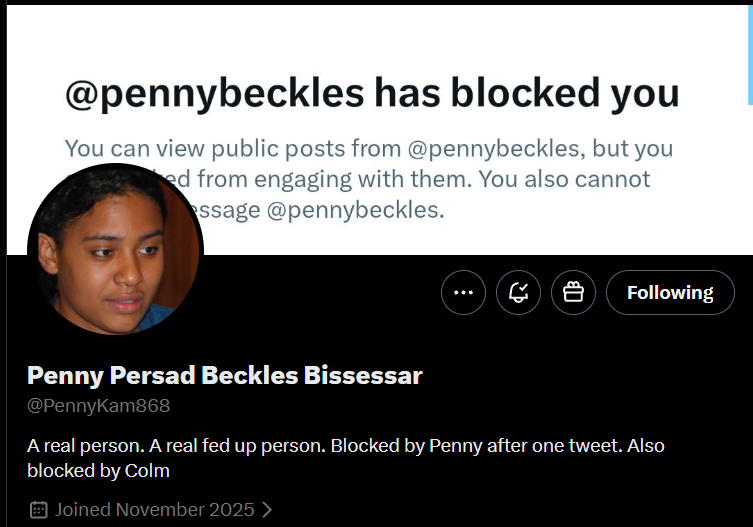
And this is not a one-night incident. Ask around and you find the same reflex operating everywhere she has a say — most visibly online, where she actively blocks citizens who criticise her. Not trolls. Not people making threats. Ordinary Trinbagonians who asked an uncomfortable question or said something unflattering, and found themselves cut off from a public figure’s public page.
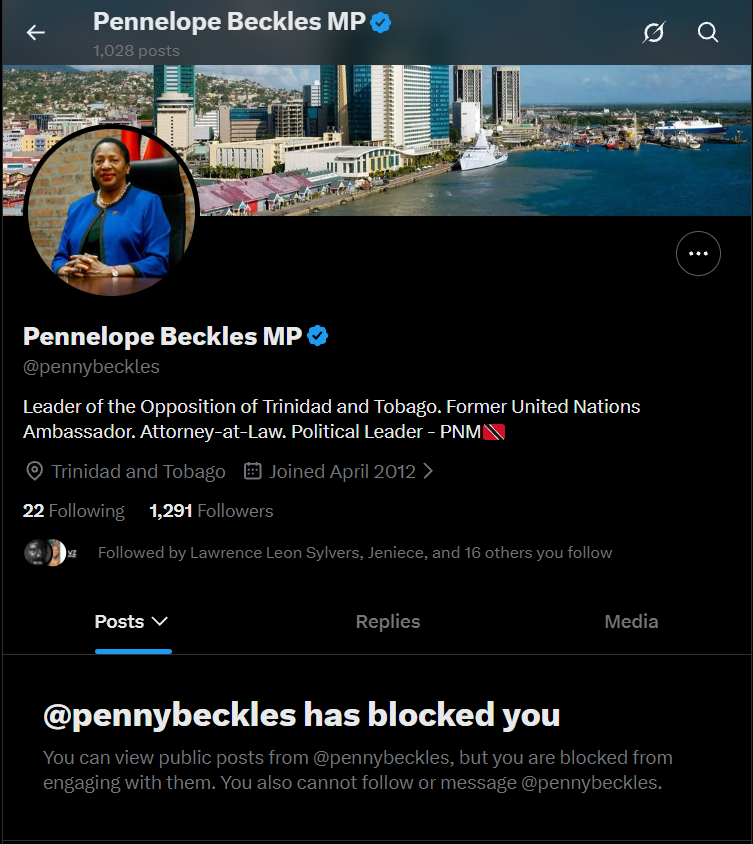
Think about the arithmetic of that. A politician’s social media is not a personal diary; it is the closest thing most citizens will ever have to a direct line to power. Blocking a citizen from it is not setting a boundary — it is removing a member of the public from a public square because they said the wrong thing. And it is a rehearsal. What you do with a block button when you have no power is a preview of what you do with the machinery of the state when you have all of it.
Talk Until the Question Dies
The third technique is subtler than the other two, and she is fluent in it. Ask her something direct and you get a ten-minute answer that never lands anywhere. The droning. The “let me be clear” that clarifies nothing. It looks like engagement, and it is the opposite: it is a way of running out the clock until the questioner gives up and the room applauds the stamina.
Silencing does not always look like a hand over a mouth. Sometimes it looks like a very long sentence. The result is identical — the question does not get answered, and the asker learns not to bother.
Switch off the camera. Block the critic. Talk until the question dies. Three tools, one purpose: make the criticism stop without ever having to address it.
Trinidad and Tobago Revolutionary Socialist Party

This Is What Authoritarianism Looks Like Before It Has Power
People expect authoritarianism to arrive in uniform. It does not. It arrives as a temperament, and the temperament is always visible early, in small things, while the person still has to ask for your vote. It looks like a leader who treats criticism as an attack rather than as information. Who divides the public into supporters and enemies. Who cannot absorb being told she is wrong.
Beckles wants to be Prime Minister of Trinidad and Tobago. Her supporters already chant that she is the “prime minister in waiting.” So it is fair — it is necessary — to ask the obvious question now, while it is still cheap to ask: if she cannot tolerate a camera in a Brooklyn restaurant or a critical comment on a Facebook page, what exactly will she tolerate with the police, the state media, and the legislation of a whole country in her hands?
Citizens Are Not an Inconvenience
Here is what the silencing reveals, and it is worse than thin skin. It is a theory of what citizens are for. In her practice, we are an audience — there to receive the message, applaud it, and share it. We are not participants. Our criticism is not input to be weighed, it is noise to be filtered. That is not a democratic relationship with a public; it is a broadcast with a mute button.
We reject that entirely. In a serious democracy the citizen is the employer and the politician is the help. Criticism is not a discourtesy you extend to your government; it is the entire mechanism by which a government is kept honest. A leader who blocks the people she intends to govern has already told you she does not intend to be accountable to them.
The Record She Cannot Block
So call it what it is. Penny the Silencer. Not because she has passed a censorship law — she has no power to pass anything yet — but because every instrument she currently controls, she uses to shrink the space where she can be questioned. The camera off. The critic blocked. The question buried under ten minutes of nothing.
She can block a citizen. She can ask a reporter to lower a camera. She cannot block the written record, and she cannot block the memory of the people who were in the room. We are writing it down. All of it.
— Slimy